Guide
How to Check If Your Price Leaves Enough Profit
Add up what a product really costs you, compare it to what you charge, and know exactly how much profit is left. Then decide if the price is high enough.
You need more than materials cost
Many makers set a price by adding a percentage to their materials cost: if materials are $5, add 50% and charge $7.50. But materials are only part of the true cost. Your price needs to cover:
- Materials cost (wax, yarn, fabric, clay, anything that goes into the product)
- Labour (your time to make it, even if you are not paid per hour)
- Packaging (boxes, labels, tape, tissue, wrapping)
- Shipping or delivery cost (if you pay shipping, the buyer sometimes expects free shipping; that is your cost)
- Platform fees or commissions (if you sell on Etsy or through a shop, they take a percentage)
- Profit (what you keep after all costs)
If your price only covers materials, you are working for free. If it covers materials plus labour, but not packaging and fees, you are losing money each sale.
The sum
Take one product and write down all these costs per unit:
- Materials cost: $
- Labour cost: $ (total wage you would pay someone to make this ÷ how many you make per hour)
- Packaging cost: $
- Shipping you pay: $
- Selling fees: $ (marketplace percentage + payment processing ÷ how many units per order, or expected units per order)
- Total cost per unit: $
- Your selling price: $
- Profit per unit: selling price − total cost = $
- Profit as a percentage: (profit per unit ÷ selling price) × 100 = %
A worked example
You make candles. Let's calculate the profit on one candle you sell on Etsy for $18.
Costs per candle: - Wax: $1.50 - Fragrance and wick: $0.80 - Jar: $1.20 - Labour: you make 6 candles per hour at $15/hour = $2.50 per candle - Packaging (box, tissue, tape): $0.60 - Shipping you pay the carrier: $0 (buyer pays) - Platform fee (example rate 6.5%; check your platform's current fee page): $1.17
Total cost per candle: $1.50 + $0.80 + $1.20 + $2.50 + $0.60 + $0 + $1.17 = $7.77
Your selling price: $18.00
Profit per candle: $18.00 − $7.77 = $10.23
Profit percentage: ($10.23 ÷ $18.00) × 100 = 56.8%
For every $18 you collect, you keep $10.23 after covering all costs of making and selling that candle. The other $7.77 goes to materials, your time, packaging, platform fees and everything else.
What if you sell direct instead?
Same candle, sold direct from your website for $18:
- No Etsy fee, but maybe you have a website cost of $20/month. If you sell 4 candles a month, that is $5 per candle.
- Payment fee (example rate 2.9% + $0.30; check your processor's current rates): (18 × 0.029) + $0.30 = $0.82
- All other costs stay the same: $1.50 + $0.80 + $1.20 + $2.50 + $0.60 + $0 + $0.82 + $5 (website share) = $12.42
Profit per candle: $18 − $12.42 = $5.58
Profit percentage: ($5.58 ÷ $18) × 100 = 31%
Direct only beats Etsy here once the $20 website cost is spread thin enough: before that cost you keep $0.35 more per candle, so you need 58 sales a month ($20 ÷ $0.35 = 57.1) before selling direct pays more. But each $18 sale now keeps only $5.58, not $10.23. The difference is where you sell and what fees you pay.
Is your profit enough?
A good profit target depends on what you need:
- If you want to earn $15/hour for your time, and labour is $2.50 per candle, you need profit to cover remaining overheads (rent, equipment, marketing, taxes, a buffer for slack months) plus a margin. Many makers aim for somewhere between 30% and 50%; set yours from your own overheads.
- If your profit is under 20%, you are leaving little room for unexpected costs, taxes, or overheads.
- If your profit is 60% or higher, you can afford to lower your price and still survive, or you have room to grow.
Check every channel you sell on
The fees are different on Etsy, Shopify, your own site, a marketplace, a wholesale shop, and at a craft fair. Do this sum for each one. You might find that one channel pays much better than another, or that one channel costs you money and you need to raise the price or stop selling there.
The more expensive the platform, the higher your price needs to be to keep the same profit.
Don't guess at labour cost
This is where most makers go wrong. They know materials cost them $5 and think "I only spend 10 minutes on it." But 10 minutes is 6 per hour, which at $15 an hour is $2.50 per unit. Add setup time, cleanup, breakage, and accounting, and the real time is almost always higher than you think.
Keep a record: how many did you make, how long did it take, including everything? Then divide. If you made 12 candles in 3 hours, that is 15 minutes each. At $15/hour, that is $3.75 labour per candle, not $2.50.
Set a minimum price
Once you know what it costs, your selling price must be at least cost + profit target. Your cost before the platform fee is $6.60, and you need 40% profit. Leave the fee out of the cost and divide by what remains after it: $6.60 ÷ (1 − 0.40 − 0.065) = $12.34. At $12.34 the fee is $0.80 and profit is $4.94, which is 40%. At $18, you make more.
If the market will not pay $12.34, you have only two choices: lower the cost (cheaper materials, faster labour, less packaging, better platform) or make something different that costs less to produce.
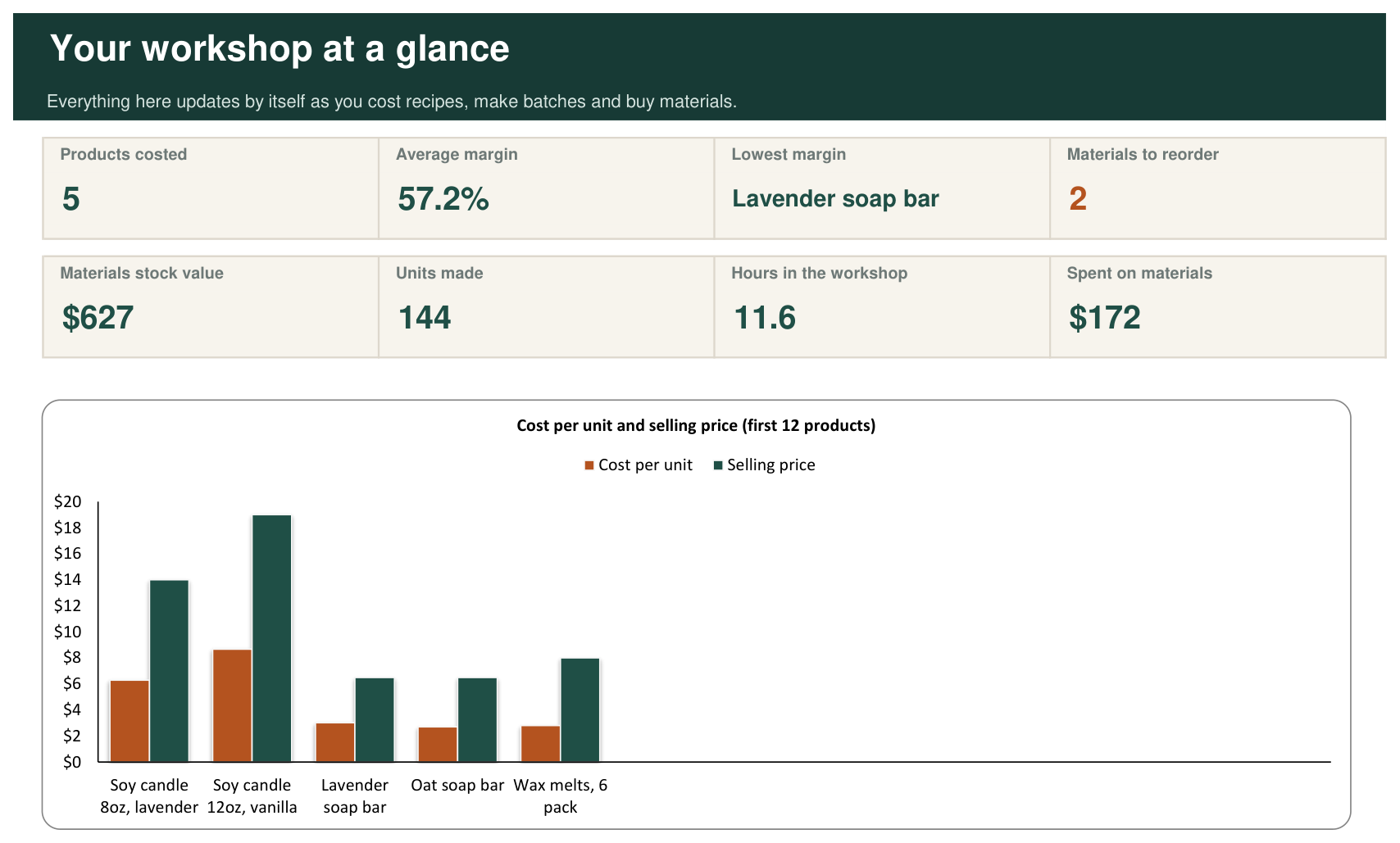
The Maker's Costing Workbook works out materials, labour and packaging per unit, your margin at your price, and the price for a target margin.