Guide
How to Cost a Batch of Handmade Products
You make twelve at a time and sell them one at a time. Here is how to get from a shelf of supplies to the true cost of a single piece, in five steps, with a candle as the worked example.
1. Turn every pack into a cost per unit
Supplies arrive in packs: a 10 kg bag of wax, a 500 ml bottle of fragrance, a box of 100 wicks. Divide what the pack cost you, including its shipping, by the pack size.
A 10 kg bag of soy wax at $42.00 plus $8.00 shipping is $50.00 for 10,000 g, or $0.0050 a gram. A 500 ml bottle of fragrance at $24.00 is $0.048 a millilitre. A box of 100 wicks at $9.00 is $0.09 a wick. A case of 12 jars at $14.40 plus $6.00 shipping is $1.70 a jar. Labels at $30.00 for 250 are $0.12 each.
2. Write the recipe for one batch
List what one batch uses, in the same units you priced the materials in. A batch of twelve 8 oz candles might use 2,160 g of wax, 190 ml of fragrance, 12 wicks, 12 jars and 12 labels.
Multiply each line by its cost per unit: wax $10.80, fragrance $9.12, wicks $1.08, jars $20.40, labels $1.44. Materials for the batch come to $42.84.
3. Add your time
Time the batch from setup to the last lid, including cleaning up. If a batch takes 75 minutes and you want to earn $25.00 an hour, your time is worth $31.25.
That is not optional. A price with no labour in it means you work for nothing, and it cannot pay a helper when you need one.
4. Add packaging and divide by the batch
Packaging that goes out with each piece, such as a box or a wrap, is a per-piece cost. At $0.12 a candle, twelve candles add $1.44.
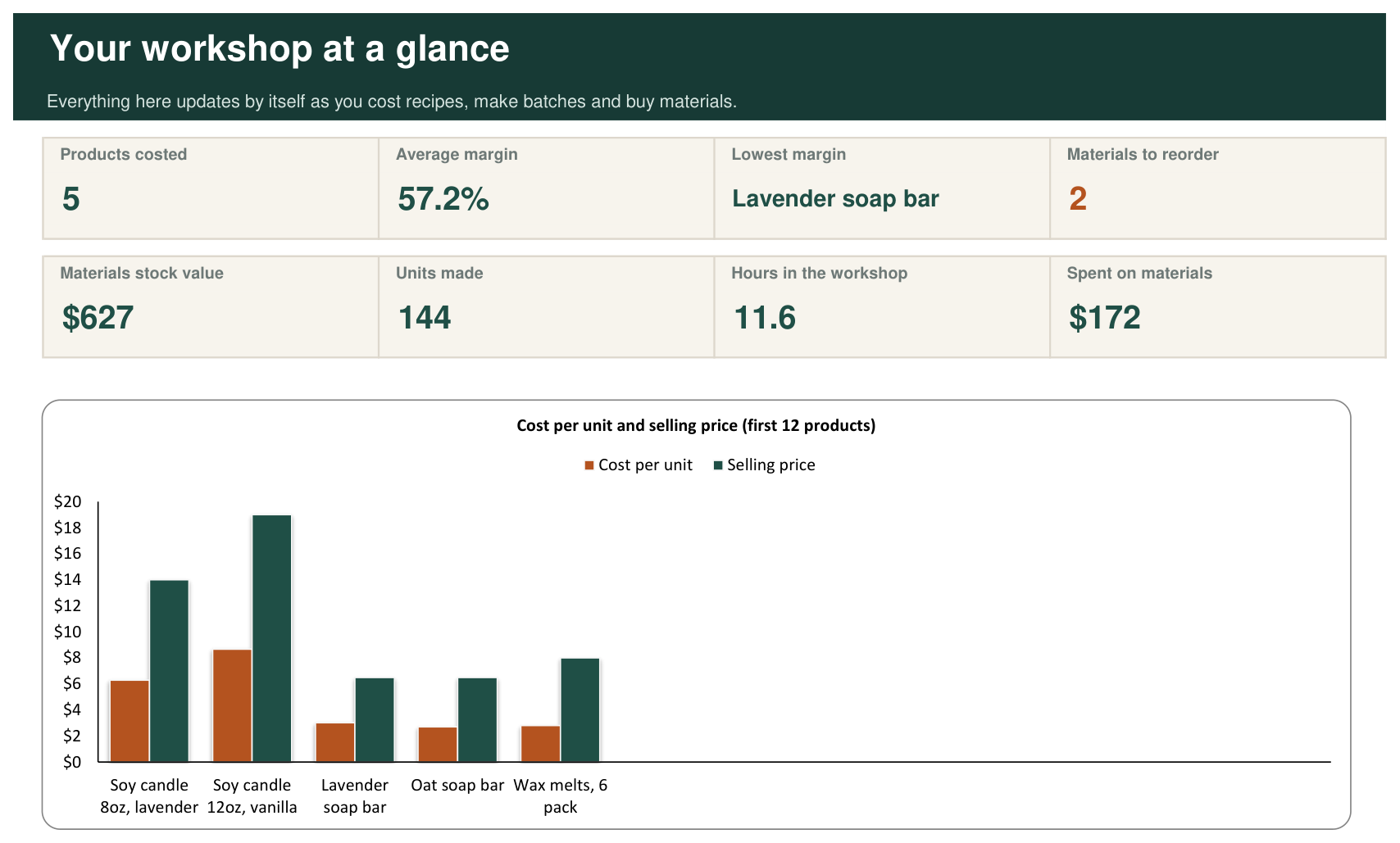
The batch costs $42.84 plus $31.25 plus $1.44, which is $75.53. Divide by 12 and one candle costs $6.29. Materials alone would have told you $3.57.
5. Set the price from the true cost
Decide the margin you need, then divide the cost by (1 minus the margin). For a 60% margin, $6.29 divided by 0.4 is $15.73. At a $14.00 price the margin is 55%, which is a choice you can now make with your eyes open.
Repeat for every recipe, and redo the sum whenever a supplier's price changes. The materials line is usually the one that moves.