Get the workbook, $19

For people who make what they sell

Know what one finished piece really costs you.

The Maker's Costing Workbook is one Excel workbook that turns the materials you buy into the true cost of a candle, a bar of soap, a jar or a loaf, with your own time priced in. Type a material once. Every recipe that uses it updates.

  • One payment, yours to keep
  • Download the moment you pay
  • Every formula checked in Excel
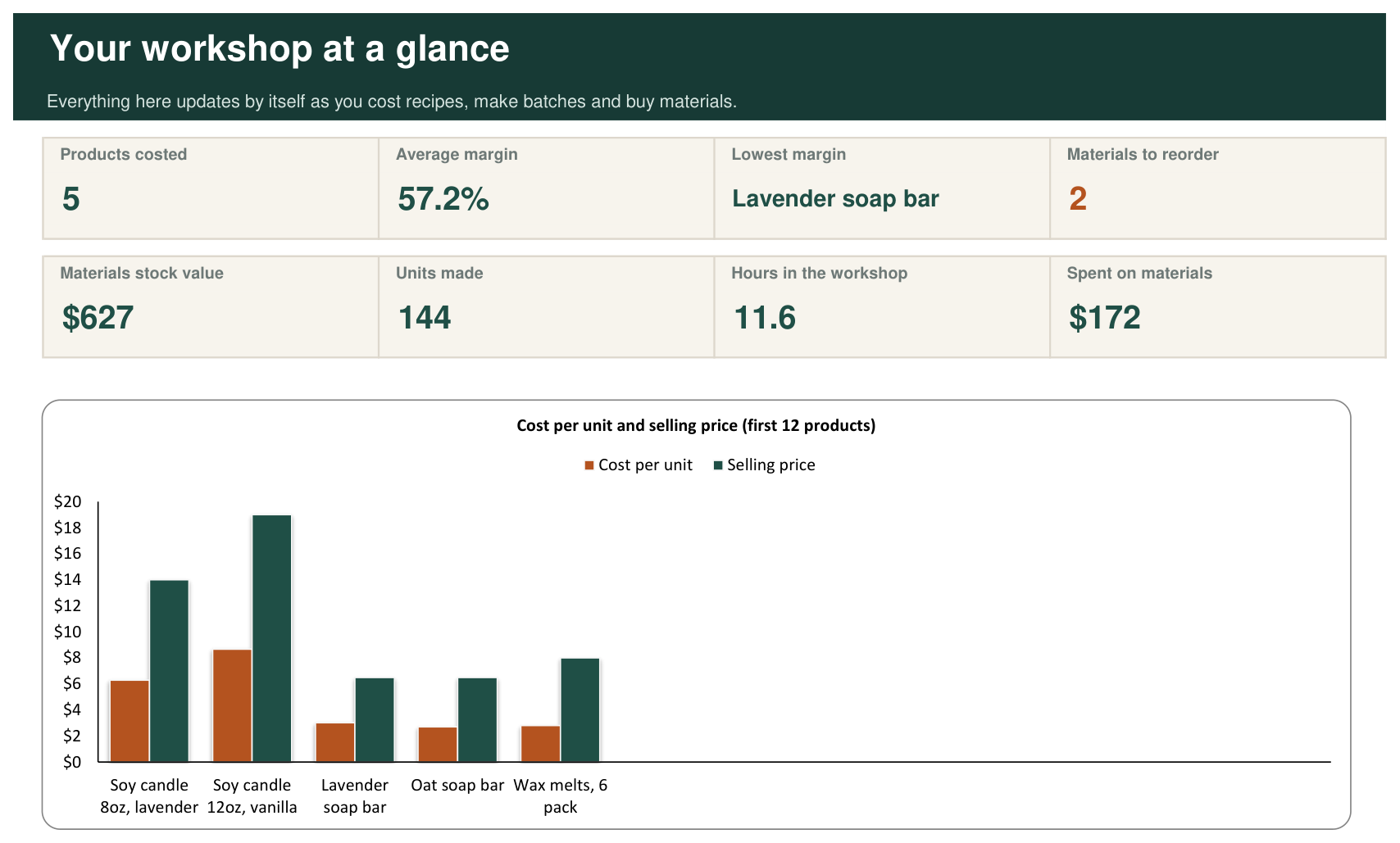
The dashboard tab: products costed, average margin, lowest margin, materials to reorder, stock value, units made, hours and spend, with a chart of cost against price.
The Dashboard tab. It updates by itself as you cost recipes, make batches and buy materials.

You know what the wax cost. That is not what the candle cost.

MATERIALS

A pack is not a unit

Wax comes by the kilo, fragrance by the bottle, wicks by the hundred. Each recipe uses a bit of each, and turning that into a cost per candle is where most makers give up.

TIME

Your hours are not free

A batch that takes an hour and a quarter has a cost, even when nobody sends you a bill for it. Leave it out and every price you set is too low.

SUPPLY

Running out mid-batch

You find out the jars are gone when the wax is already melted.

What's inside

From the pack you buy to the price you charge.

Real screenshots of the workbook, filled in with a sample candle and soap maker so you can see it running.

Dashboard tab with eight headline numbers and a chart comparing cost per unit with selling price.
Dashboard. Products costed, average and lowest margin, materials to reorder, stock value, units made, hours in the workshop and money spent on materials. Nothing to type.
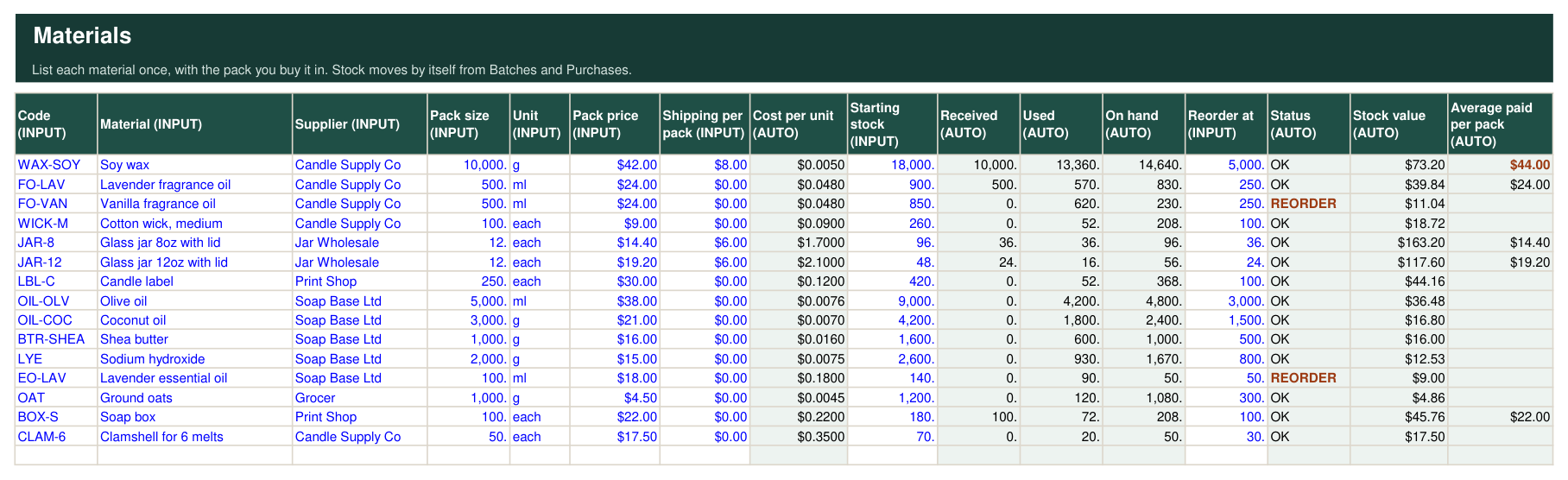
Materials tab listing fifteen materials with pack size, unit, pack price, cost per unit, stock on hand and status.
Materials. Enter each material with the pack you buy it in. It works out the cost per gram, millilitre or piece, tracks what you have used and received, and turns orange when it is time to reorder.
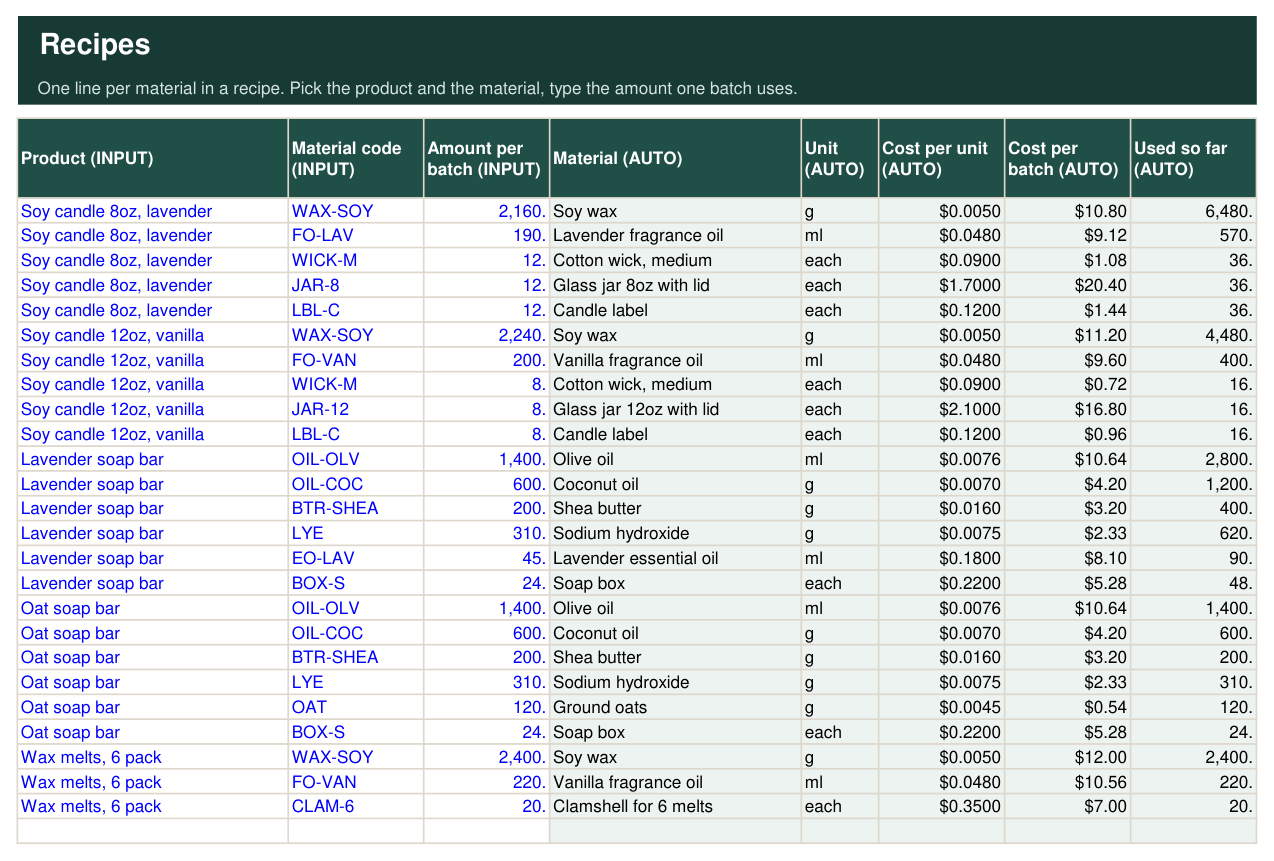
Recipes tab with one line per material per product, showing cost per batch and materials used so far.
Recipes. Pick the product, pick the material, type the amount one batch uses. The cost of every line fills in, and so does how much of each material your batches have used.
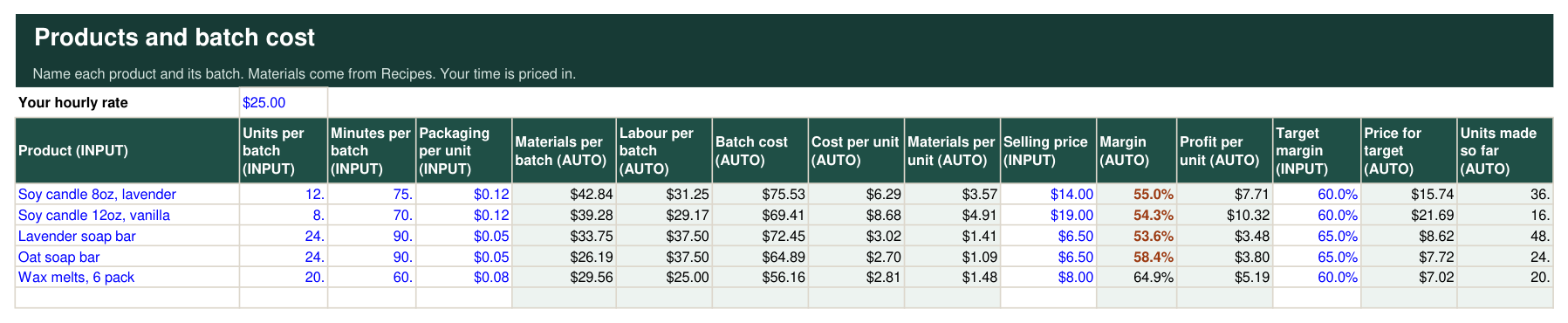
Products tab showing materials per batch, labour, batch cost, cost per unit, margin and the price for a target margin.
Products and batch cost. How many a batch makes and how long it takes. Materials come from Recipes, your time comes from the hourly rate you set, and out comes the cost per unit, your margin and the price that hits your target.
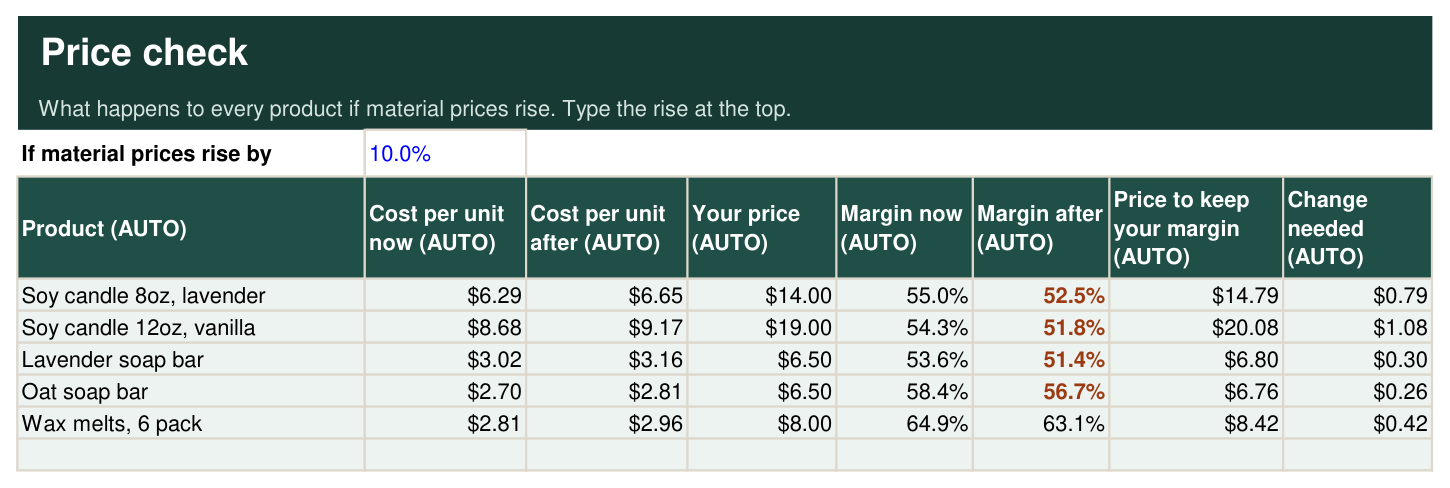
Price Check tab showing cost, margin and the price needed to keep the same margin after a 10 percent rise in material prices.
Price check. Type a rise in material prices. For every product, see the new cost, the new margin and the price that keeps your margin where it was.

Also inside: a Batches tab to log what you make, a Purchases tab to log what you buy, and a Start Here guide.

How it fits together

Type each number once.

Every tab reads from the ones before it, so a change in one place is a change everywhere.

  1. MaterialsA 10 kg bag of soy wax for $42 plus $8 shipping is $0.0050 a gram. You type the pack; the workbook does the division.
  2. RecipesAn 8oz candle batch uses 2,160 g of wax, 190 ml of fragrance, 12 wicks, 12 jars and 12 labels. Each line costs itself from Materials.
  3. ProductsTwelve candles from a 75-minute batch at $25 an hour: $42.84 in materials, $31.25 in labour, $1.44 in packaging. Cost per candle $6.29. At $14, a 55% margin.
  4. Batches and PurchasesLog two batches and 4,320 g of wax leaves stock. Log a new bag and 10,000 g comes back. Stock that reaches its reorder level turns orange.

One candle, costed

Materials per candle
$3.57
Your time per candle
$2.60
Packaging
$0.12
Cost per candle
$6.29
Margin at $14.00
55.0%

Materials alone would say this candle costs $3.57. More than half of the real cost is time and packaging.

These are the sample numbers that ship inside the workbook. Type over them with your own.

Get the workbook

Pricing

One payment. No subscription.

Pay once and keep the file. No account to create, nothing to renew.

For makers

The Maker's Costing Workbook

For anyone who makes in batches and sells by the piece.

$19once
Get the workbook for $19
  • Materials with cost per gram, millilitre or piece
  • Recipes built from your materials
  • Batch cost and cost per unit, your time included
  • Margin and the price for your target margin
  • Materials stock with reorder alerts
  • Batch log and purchase log
  • Price check for a rise in material costs
  • Dashboard and Start Here guide
  • Room for 60 materials, 40 products and 300 recipe lines

The Back Office Kit

The other half: stock, orders, invoices, line sheet and monthly profit for the finished products.

$19once
See the Back Office Kit
  • The cost per unit from this workbook is the landed cost the Kit asks for
  • Dashboard, products and pricing, inventory, orders
  • Monthly profit and cash, break-even
  • Invoice maker and wholesale line sheet

Secure checkout by Stripe. Pay by card, Apple Pay and more. Your download is ready the moment you pay.

It works, or we make it right.

Before release the workbook is opened in Excel and put through 90 automated checks. The answers are worked out separately and compared, so the numbers you see are numbers you can trust.

If a file will not open or a number is wrong, email us within 14 days. We fix it or refund you.

Questions

What exactly do I get?

One Excel workbook, delivered as a download the moment you pay. It arrives filled in with a sample candle and soap maker so you can see every tab working before you add your own materials and recipes.

Eight tabs: Start Here, Dashboard, Materials, Products, Recipes, Batches, Purchases and Price Check.

What do I need to use it?

Microsoft Excel. The workbook is built and checked in Excel for Windows. It uses only standard Excel functions, with no macros and no add-ins, so there is nothing to install and nothing for your computer to warn you about.

What kinds of making does it suit?

Anything made in batches from measured materials: candles, soap, bath and body products, baked goods, preserves, jewellery, small-batch anything. You choose the unit for each material, grams, millilitres or pieces, and the recipe uses the same unit.

Does it tell me how to make things?

No. It costs your recipes; it does not write them. It gives no advice on formulation, safety or labelling. You bring the recipe, it brings the numbers.

How does it price my time?

You set an hourly rate at the top of the Products tab and enter how many minutes a batch takes. Labour for the batch is spread across the units in it, so a 75-minute batch of 12 candles at $25 an hour adds $2.60 to each candle. Set the rate to zero if you want to see material costs alone.

How does stock work?

Each material has a starting stock in its own unit. Every batch you log uses up what its recipe calls for; every purchase you log adds packs back. On hand, stock value and a REORDER flag update by themselves, so you see what is running low before you start a batch.

What is the Price Check tab for?

Material prices move. Type a rise, say 10%, and for every product you see the new cost per unit, the new margin, and the price that would keep your margin where it is today. It answers "what do I have to charge now?" for your whole range at once.

How does it work with the Back Office Kit?

This workbook works out what a finished unit costs you to make. The Back Office Kit takes that number as the landed cost and runs your stock of finished goods, your orders, your invoices, your line sheet and your monthly profit. They are two separate files; you type the cost per unit from one into the other.

I am not good with spreadsheets. Will I manage?

Yes. You only ever type in cells with blue text. Everything in grey is worked out for you and locked, so you cannot break a formula by accident. Products and materials are picked from dropdowns, and the Start Here tab walks you through setup in order.

How long does it take to set up?

About fifteen minutes for a small range: list your materials with the packs you buy, name your products, and enter each recipe. After that, day to day use is one line per batch and one line per purchase.

Is this a subscription?

No. You pay once and the file is yours to keep. There is nothing to renew and no account to log in to.

How do I get it, and what if I lose the file?

Straight after you pay you land on your download page. Save that page's address and you can download the file again whenever you need it.

Is my data private?

Yes. The workbook runs entirely on your own computer. It does not connect to the internet or to anything else, and nothing you type is sent to us or anyone else.

Can I change it to suit my business?

Yes. The formula cells are locked to protect them, but there is no password. You can unlock any tab, add rows, and rename anything.

What if I need help?

Email jacob.squareone@gmail.com. We reply within one business day.
Price from what it really costs, not what you hope it costs.