Guide
How to Set a Sales Target That Matches Your Goal
Turn "I want to earn $X" into the exact number of units you need to sell at your current price, and check whether that target is realistic for your market.
Profit target vs. revenue target
Many makers confuse these. Revenue is the total money that comes in. Profit is what's left after you pay your costs (materials, shipping, time, fees).
If you want to earn $2,000 a month, you need a profit target, not a revenue target. But the calculator also needs to know your selling price and your cost per unit, because your profit depends on both.
Example: You make candles at $5 cost per unit and sell them for $15. Your profit per unit is $10. To earn $2,000 a month, you need 200 sales ($2,000 ÷ $10). Your revenue would be 200 × $15 = $3,000.
If you aimed for $2,000 in revenue, you would plan for about 134 sales ($2,000 ÷ $15 = 133.3) and fall short: you actually need 200. Use the calculator to work out the real number.
How to account for refunds, returns and discounts
Your profit per unit is your starting point, but real sales are messier.
Refunds and returns: If you average 5% of sales back as returns, treat it as 5% fewer sales. Example: to hit 200 sales net, plan for 211 orders (5% returns = 211 × 0.95 ≈ 200).
Discounts and bundles: If you offer a 20% bulk discount to wholesale buyers or run regular sales, calculate your blended average profit per unit across all your prices. Example: 70% of sales at $15 (profit $10), 30% at $12 (profit $7). Blended: (0.7 × $10) + (0.3 × $7) = $9.10 average profit. Use $9.10 in the calculator.
Platform and payment fees: These come out of your revenue before you pocket profit. If your platform takes, say, 6% plus 3% plus $0.20 per order (example rates; check your platform's fee page), fees on a $15 sale are $0.90 + $0.45 + $0.20 = $1.55. $15 − $1.55 − $5 = $8.45 profit. Use $8.45.
Convert your target to daily or weekly units
Monthly targets can feel abstract. Break them down.
If you need 200 units per month and you work 5 days a week, that's 10 units per day average (200 ÷ 20 working days). If you work 7 days a week, it's roughly 6–7 per day.
Do 6–7 units per day feel realistic? If you work at a craft fair, do you sell 30–40 units over 5 hours? If you sell online only, do you get 6–7 orders a day? If the daily number feels too high, your goal may not be achievable without changing something (your price, your costs, or your marketing).
Know if your target is realistic
Before you commit to a sales goal, test it against reality.
Sales channel capacity: A retail shop that's open 40 hours a week can physically hold only so many transactions. An online shop can theoretically have unlimited orders, but your production and shipping speed limit you. If you make each item by hand and take 30 minutes per unit, you can make at most 16 per day working solo (8 hours ÷ 0.5). If your target is 25 per day, you need help or a faster method.
Market demand: Do buyers actually want your product at this volume and price? Selling 200 units of a niche item per month is harder than selling 200 of a commodity. If you are new or unknown, your early sales will be slower.
Seasonality: Many makers have quiet winters and busy summers, or the opposite. If your target assumes steady sales year-round, you'll miss it half the year. Use the calculator with an annual goal instead, then plan for peaks and valleys.
Competition and pricing: If similar products sell for less, your target price may not hold. If your product is unique or premium, it might hold more. Check what similar makers charge and what they report about sales volume (though most won't tell you).
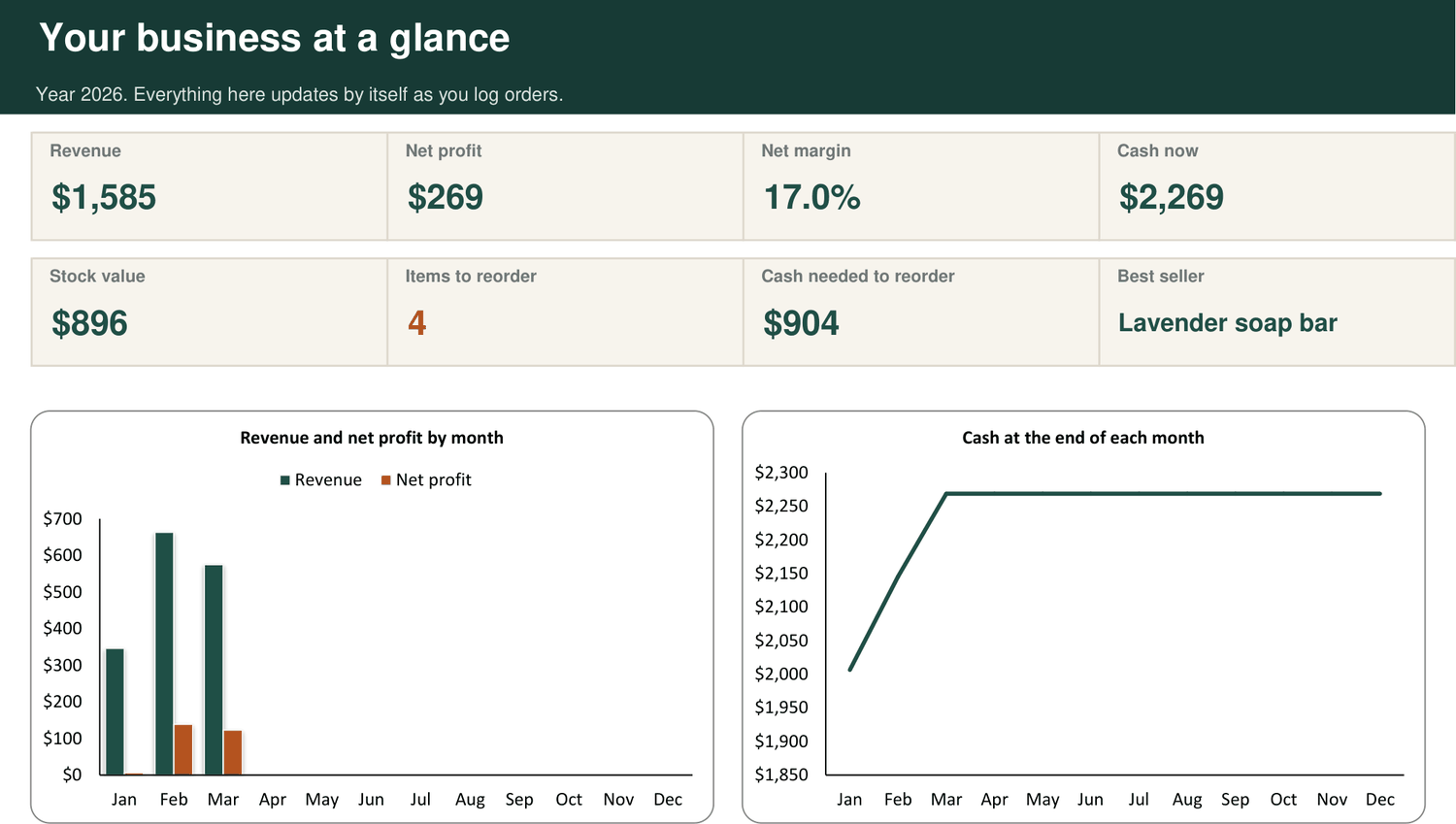
Use the break-even calculator to turn your costs and goal into a unit goal. Then ask: can I make that many units? Can I sell that many units? If the answer is no to either, either lower your target, raise your price, reduce your costs, or find a new sales channel. The Back Office Kit logs your orders and shows revenue and net profit by month, so you can compare each month with your target.