Guide
How to Include Your Labor in Your Product Cost
Work out what you actually earn per hour by adding your labor time to the materials cost, so you stop underpricing your handmade products.
Why your hourly rate matters
Many makers price by materials cost plus a markup percentage, but forget to account for their own time. If a candle uses $3 of wax and you mark it up 100%, you charge $6. But if it takes 45 minutes to make (including measuring, pouring, cooling, labeling, packaging) and you make 50 candles a week, your hourly rate is far lower than you think. 50 candles × 45 minutes = 37.5 hours of work for perhaps $150 profit if customers pay only slightly above cost.
The fix is to add your labor cost to the materials cost before you calculate the markup. Then your price reflects the time you spend.
The sum: two steps
First: work out your target hourly rate. - What do you want to earn per hour? ($15, $20 or $25 an hour; pick a realistic figure for your market and experience). - How long does one item take to make, including materials prep, making, finishing, packaging and labeling? Write this in hours or minutes. - Multiply: target hourly rate × time per item = labor cost per item.
Second: add labor to materials, then mark up. - Total cost per item = materials cost + labor cost. - Suggested selling price = total cost / (1 - target margin). A 40% margin means price = cost / 0.6.
A worked example
A soap maker spends $1.50 on ingredients per bar (oils, fragrance, colorant, packaging). She wants to earn $18 per hour. Each bar takes 15 minutes to make: mixing, molding, labeling and boxing (15 minutes = 0.25 hours).
Labor cost per bar: $18 × 0.25 = $4.50. Total cost per bar: $1.50 + $4.50 = $6.00.
To achieve a 40% margin: price = $6.00 / 0.6 = $10.00.
At that price, she earns $4.00 per bar profit (the $4.50 labor cost is built into the price she charges customers). If she makes and sells 50 bars a week, she earns $4.50 × 50 = $225 in labor, plus enough margin to cover overheads and make a profit.
Without adding labor: if she had priced at $1.50 × 2 = $3.00, she would earn only $1.50 per bar in margin—not enough to cover her time.
When to recalculate
Your labor time changes as you get faster or as orders grow. Recalculate every quarter or whenever your production process changes. If you introduce a new tool or technique that cuts time by 20%, you can afford to lower your price slightly and stay more competitive.
Also recalculate your target hourly rate if the market moves. Handmade products are not a race to the bottom. If your market will bear a higher price (because you have an audience, or your product is unique, or you have several years of experience), raise your target hourly rate.
Put it in a sheet
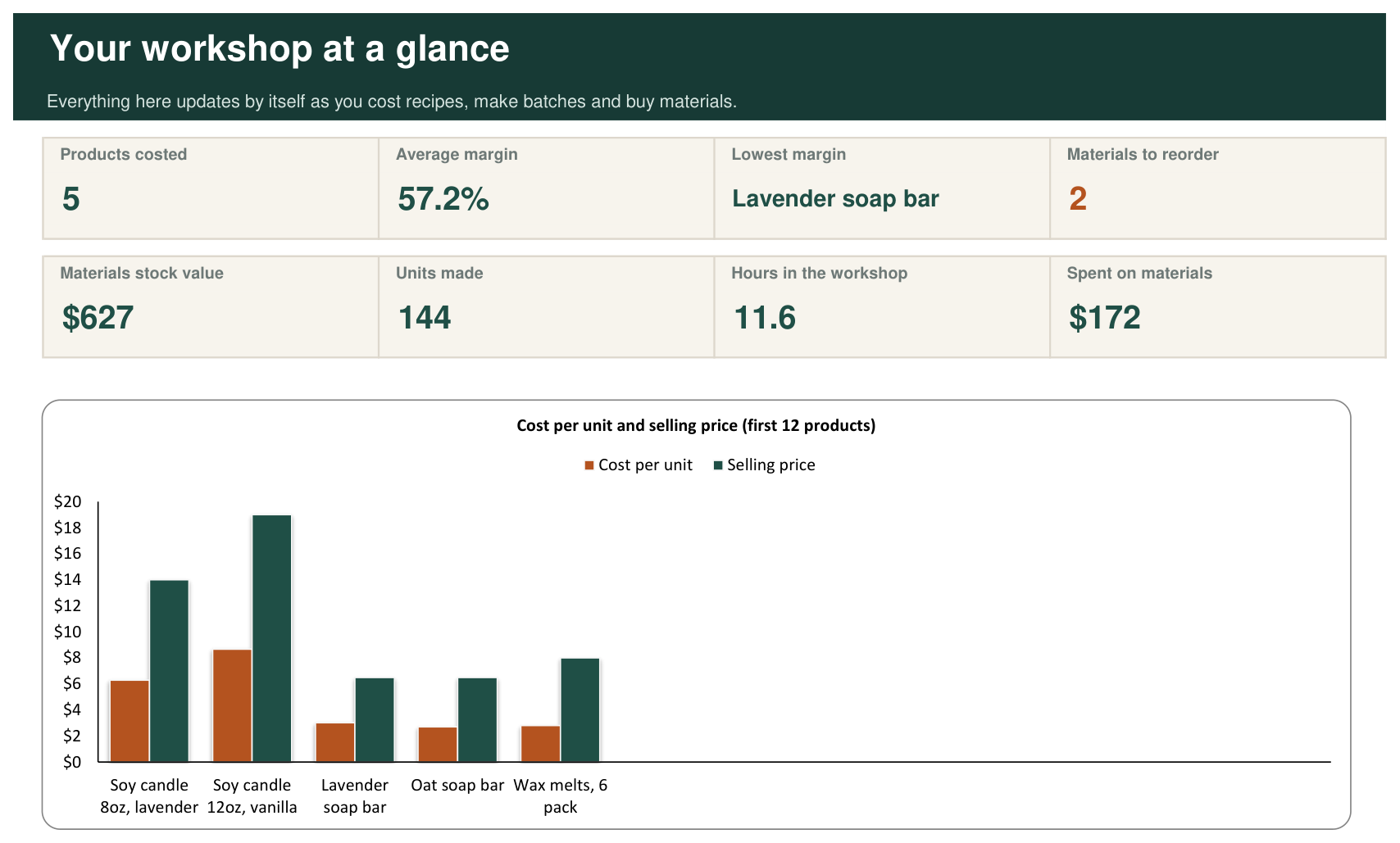
Track materials cost and labor time for each item. Our Maker's Costing Workbook does this: enter your materials cost, how many hours it takes, and your target hourly rate, and it works out cost per unit and the recommended price. The workbook recalculates as you improve your speed or change your rates.