Guide
How to Work Out Postage Costs for a Small Shop
Find the true cost of sending one order, decide whether to charge for postage or build it into your price, and see how a few extra grams can change your profit.
Postage is more than the stamp
When you send an order you pay for more than the carrier's charge. You also pay for the box or mailer, padding, tape and a label. Add them all up and call it your cost to ship. Leave any of them out and every order quietly earns less than you think.
Step 1: Add up one parcel
Take a typical order and list every item. The numbers here are invented examples.
- Carrier charge: $6.00
- Box and padding: $1.50
- Tape and label: $0.10
Cost to ship: $6.00 + $1.50 + $0.10 = $7.60.
Step 2: Watch the weight bands
Carriers usually price by weight band. Check your carrier's current price list. The bands below are made up to show the effect:
- Up to 250 g: $4.00
- Up to 500 g: $5.50
- Up to 1 kg: $7.50
Say a candle weighs 380 g and its box weighs 120 g. Together that is exactly 500 g, so you pay $5.50. If the box were 140 g, the parcel would be 520 g and the charge would jump to $7.50. That is $2.00 more for 20 g. A lighter box or a smaller mailer can be worth more than a cheaper carrier.
Step 3: Use an average, not your best case
Not every order falls in the cheapest band. Suppose three recent orders cost $4.00, $5.50 and $7.50 in carrier charges. The average is ($4.00 + $5.50 + $7.50) / 3 = $17.00 / 3 = $5.67. Use the average when you plan prices, and keep the real cost of each order so the average stays honest.
Step 4: Charge for it or build it in
Take an order with $40 of products that cost you $14 to make, and a cost to ship of $7.60.
Option A: charge the buyer $7.60 for postage. The buyer pays $47.60. You keep $40 - $14 = $26.00, because the postage payment covers the postage cost.
Option B: "free postage", with nothing added. The buyer pays $40. You keep $40 - $14 - $7.60 = $18.40.
Option C: "free postage", with the cost built into the price. Raise the price to $47.60 and show shipping as free. You keep $47.60 - $14 - $7.60 = $26.00, the same as Option A.
Option B is the trap. It feels friendly, but it cuts your profit on this order by $7.60, from $26.00 to $18.40, which is 29% less. If you want to offer free postage, make sure the price carries it.
Step 5: Set a free-postage threshold carefully
Many shops offer free postage above a set order value. Before choosing the number, work out the profit on an order at that value after paying the cost to ship. If the profit is thin, raise the threshold. Check the maths on your cheapest product, since that is where postage hurts most. On a $10 item with a $5.50 carrier charge, postage alone is more than half the price.
Common mistakes
- Counting only the carrier charge. Packaging is a real cost.
- Pricing from your best-case band. Use the average of real orders.
- Forgetting returns and replacements. If a parcel is lost or comes back, you pay twice. Keep a small allowance if it happens to you.
- Never re-checking. Carrier prices change. Look at the price list every few months.
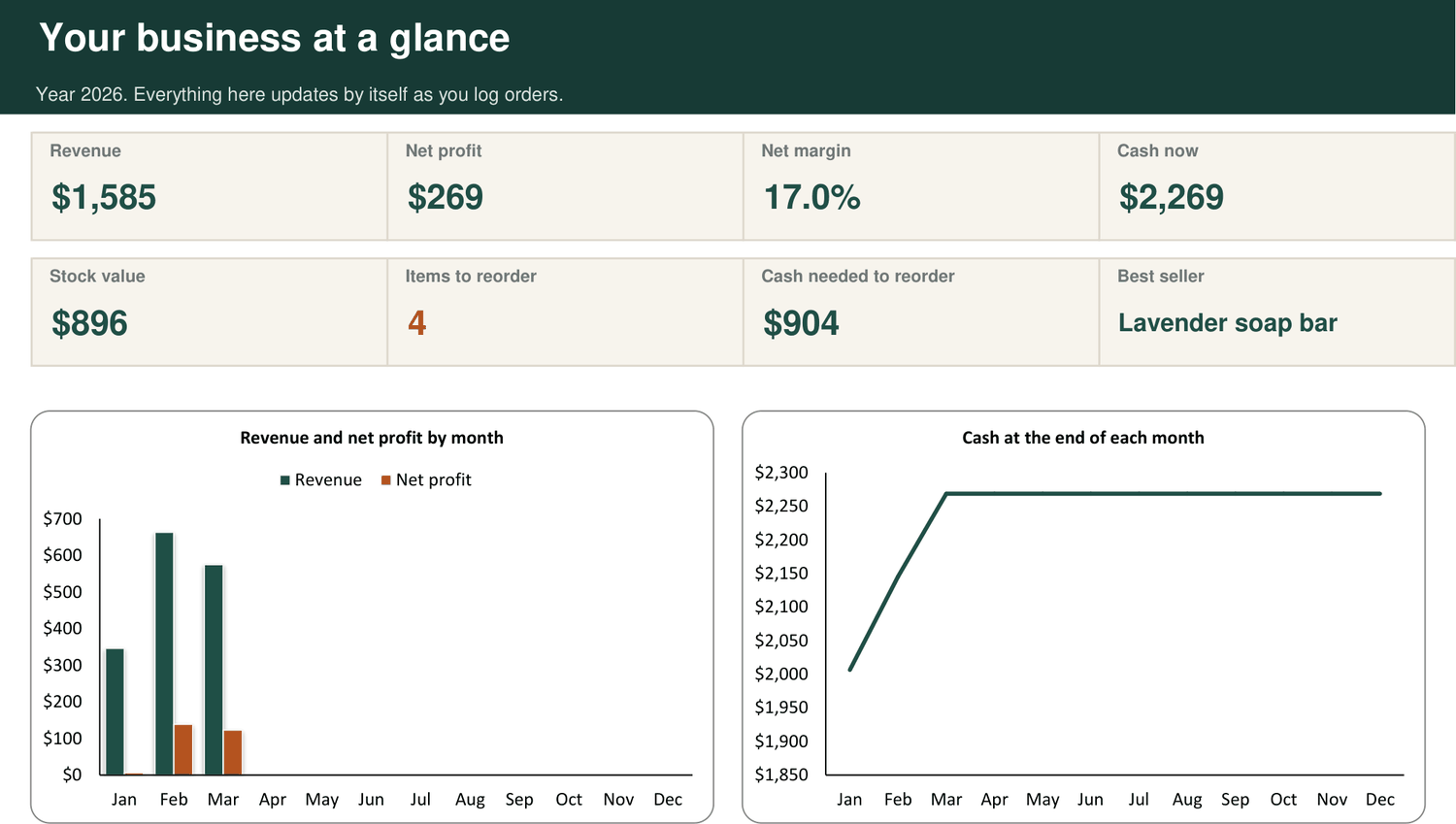
Put your own numbers into the free profit margin calculator on this site to see what you keep after postage. The Back Office Kit (for Microsoft Excel) logs each order with its cost of goods and profit, and its Monthly tab takes your fees and other costs, such as postage, to show net profit by month.